 US Hwa Rang Kwan
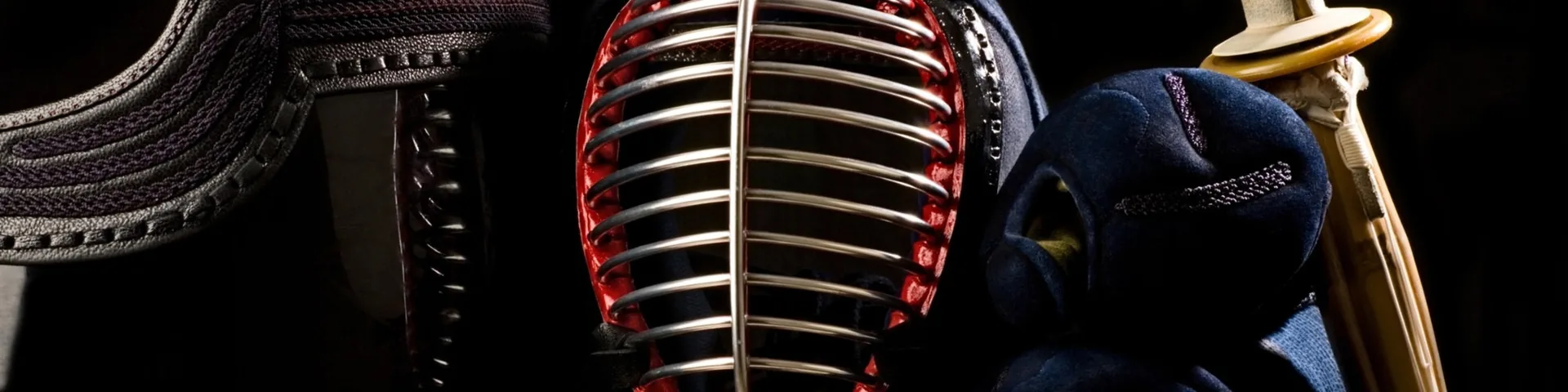
A Korean sword is called a geom (검) or a do (도): the Encyclopedia of Korean Culture says a blade with two edges was originally called geom and a blade with one edge do, though over time the two words came to be used for both. Traditional Korean swords and bladed weapons include the hwando, the single-edged sword Joseon soldiers wore; the ungeom, the large sword worn by officers guarding the king at major royal events; the saingeom, a sword made when a tiger year, month, day and hour all came together; and the woldo, a long-handled weapon with a half-moon blade. The Korea Kumdo Association traces the Bongukgeom sword method in Kumdo's history to a hwarang of Silla, and says Kumdo training builds focus, patience and balanced whole-body development.
What is a Korean sword called?
The general Korean words are geom (검) and do (도). In the Encyclopedia of Korean Culture's entry on Bongukgeom, swords with an edge on both sides were once called geom and swords with an edge on one side were called do; later the two words were mixed, and the everyday word kal (칼) came to mean both kinds together (dogeom).
That is why many sword names end in -do or -geom. The names below come from Korean public sources: the Encyclopedia of Korean Culture and the Joseon Dynasty Annals dictionary (Sillokwiki), both run by the Academy of Korean Studies, and the Korean government's policy briefing site.
What are the names of traditional Korean swords?
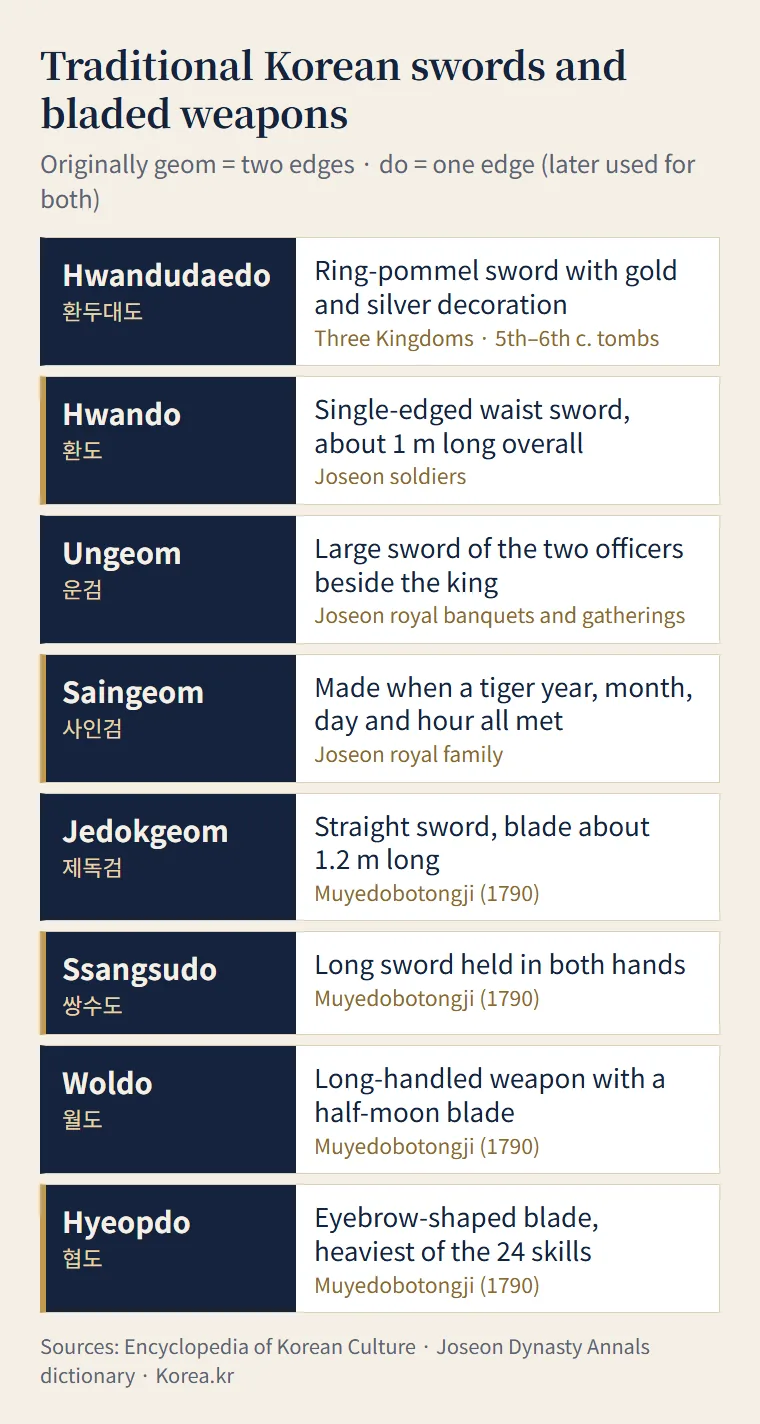
Here are eight traditional Korean swords and bladed weapons, from the Three Kingdoms period to the late Joseon Dynasty.
- Hwandudaedo (환두대도), the ring-pommel sword. The Encyclopedia of Korean Culture describes it as a sword whose handle ends in a ring. Most were found in tombs of the Three Kingdoms ruling class, decorated with gold and silver, and the typical examples come from 5th- and 6th-century tombs of Baekje, Gaya and Silla. They were usually found still worn at the waist of the person buried.
- Hwando (환도). The Encyclopedia of Korean Culture defines the hwando as a military sword worn with the old military uniform, a waist sword about 1 m long overall. The Joseon Dynasty Annals dictionary says that in the Joseon Dynasty most close-combat weapons with a long single-edged blade were called hwando, made both for the military and for ceremonies.
- Ungeom (운검). The ungeom (운검) was both a large sword and the temporary post, of the second rank or higher, held by the two military officers who wore it and stood guard on the king's left and right at major state banquets and gatherings. The Encyclopedia of Korean Culture says the scabbard of their sword was wrapped in fish skin and painted vermilion, and the decorations were white silver.
- Saingeom (사인검). A Korean government article on the saingeom explains that a sword made when all four of the tiger year, month, day and hour came together was called a saingeom, and that such swords were said to drive away evil. On the saingeom described in that article, one side of the blade is inlaid in gold with the seven stars of the Big Dipper and the 28 lunar mansions, and the other side with a charm against evil.
- Jedokgeom (제독검). The Encyclopedia of Korean Culture describes the jedokgeom as a straight sword with a blade about 1.2 m long and 5 cm wide.
- Ssangsudo (쌍수도). The ssangsudo was a sword held and used with both hands, longer than the yedo group of swords that included the hwando.
- Woldo (월도). The Joseon Dynasty Annals dictionary says the woldo got its name because its blade is shaped like a half moon. It came in an infantry version and a mounted version; the mounted woldo had a blade of 2 cheok 8 chon and a handle of 6 cheok 4 chon.
- Hyeopdo (협도). The hyeopdo was a late-Joseon pole weapon shaped like the woldo, one of the 24 martial skills. Its blade was shaped like an eyebrow, with a 7-cheok handle, a 3-cheok blade and a weight of 4 geun, and it was the heaviest weapon of the 24 skills.
What was the hwando, the sword of Joseon soldiers?
The hwando was the sword that Joseon soldiers and others wore. According to the Joseon Dynasty Annals dictionary, the name hwando first appears in Korean records in the reign of King Chungnyeol of Goryeo: in 1277, the king had 1,000 hwando made in Chungju when an envoy from the Yuan dynasty arrived.
The "hwan" in hwando means something round, and the same dictionary gives two explanations: the round hand guard, or, as the Yungwon pilbi says, the round ring that ties the scabbard to the waist. The dictionary says the Yungwon pilbi's view can be seen as the more likely one. Early Joseon scabbards were wrapped in fish skin and painted black or vermilion, with two rings on the scabbard for a cord tied at the waist.
The hwando changed over time. Late-Joseon hwando were relatively longer, and by the end of the Joseon Dynasty the hwando gradually lost its meaning as a weapon and became a ceremonial object.
Which Korean weapons are in the Muyedobotongji?
The Muyedobotongji is the Joseon martial arts manual that records 24 fighting skills, completed in 1790. The Encyclopedia of Korean Culture says scholars including Yi Deok-mu, Bak Je-ga and Baek Dong-su compiled it by royal order to train soldiers, and that it explains each skill with pictures.
- Volume 1: six skills, including the jangchang, dangpa and nangseon.
- Volume 3: eight skills, including jedokgeom, Bongukgeom, paired swords (ssanggeom), mounted paired swords, woldo, mounted woldo and hyeopdo.
- Volume 4: six skills: gwonbeop, gonbong, pyeongon, mounted pyeongon, gyeokgu and masangjae.
Bongukgeom, "the sword art of our own country," is done with a yodo, a sword worn at the waist that weighs about 1 kg, and in real combat it was held firmly in both hands. Its form has 32 movements.
How does Kumdo carry on Korean sword traditions?
The Muyedobotongji says Bongukgeom grew out of the sword art of Hwang Chang-rang, a boy of Silla, according to the Encyclopedia of Korean Culture. The Korea Kumdo Association, in its history of Kumdo, says the Bongukgeom sword method recorded in the 1790 Muyedobotongji traces back to Hwang Chang-rang, a hwarang of Silla.
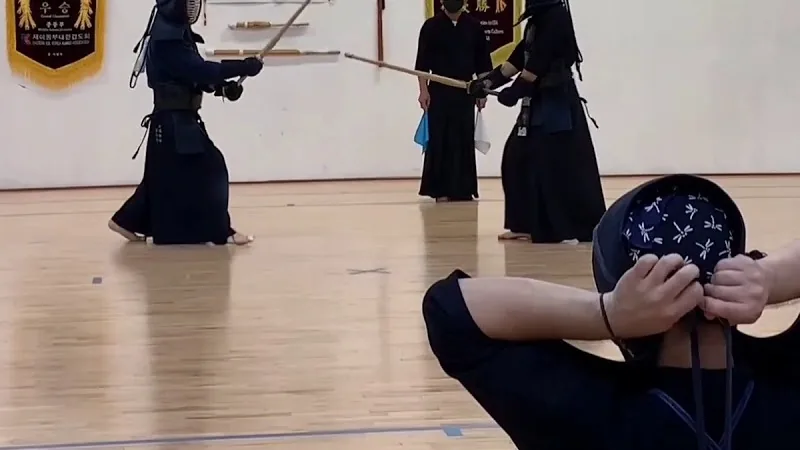
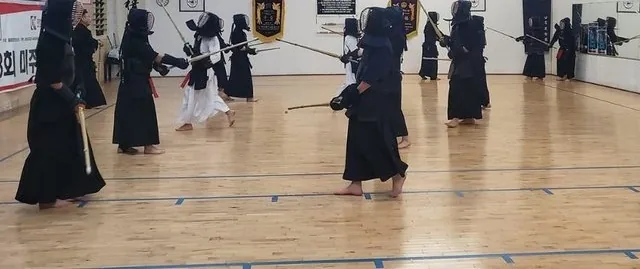
Kumdo practice uses bamboo and wooden swords. The Korea Kumdo Association lists the uniform, hogu (protective armor), jukdo (bamboo sword) and mokgeom (wooden sword) as Kumdo equipment, and the Encyclopedia of Korean Culture describes a Kumdo match as two players in hogu striking or thrusting at set targets with a jukdo under fixed rules.
What are the benefits of Kumdo?
Learning the Korean sword today is also a way to train body and mind. The Korea Kumdo Association says Kumdo training builds strong focus, patience, decisiveness and calm, along with balanced whole-body development, and that stronger heart and lung fitness helps build endurance, quickness and agility. It adds that Kumdo helps young people with emotional development and manners.
Kumdo is also a sport for the long run. The Encyclopedia of Korean Culture says anyone can train in Kumdo throughout life, regardless of age or sex.
FAQ
What is the Korean word for sword?
The Korean words are geom (검) and do (도). Geom originally meant a blade with two edges and do a blade with one edge, but the two came to be used for both; kal (칼) is the everyday word.
What is a traditional Korean sword called?
One traditional Korean sword is the hwando, the single-edged waist sword worn in the Joseon Dynasty, about 1 m long overall. Other names include the ungeom, the saingeom and the ring-pommel hwandudaedo of the Three Kingdoms period.
What is Korean sword fighting called?
Kumdo (검도) is a Korean martial art practiced with bamboo swords and protective armor, and US Hwa Rang Kwan translates the name as "way of the sword." The Encyclopedia of Korean Culture describes it as a match in which two players in hogu armor strike or thrust at set targets with a jukdo (bamboo sword). Read more in What is Kumdo?
Where can you see a saingeom today?
A saingeom can be seen at the National Palace Museum of Korea, according to the Korean government's policy briefing site. The handle of that sword has been lost.
Learn the Korean sword at US Hwa Rang Kwan
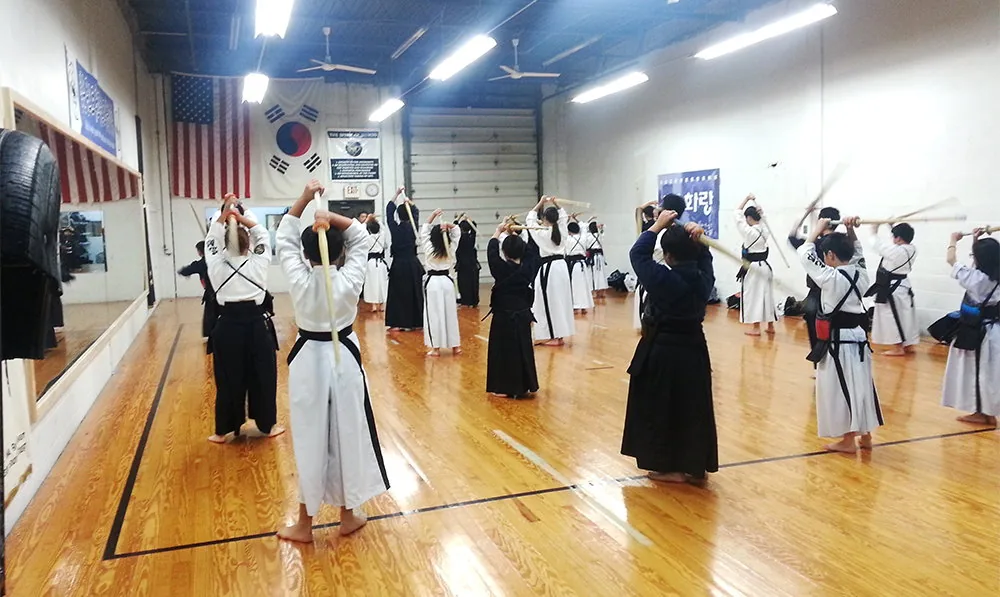
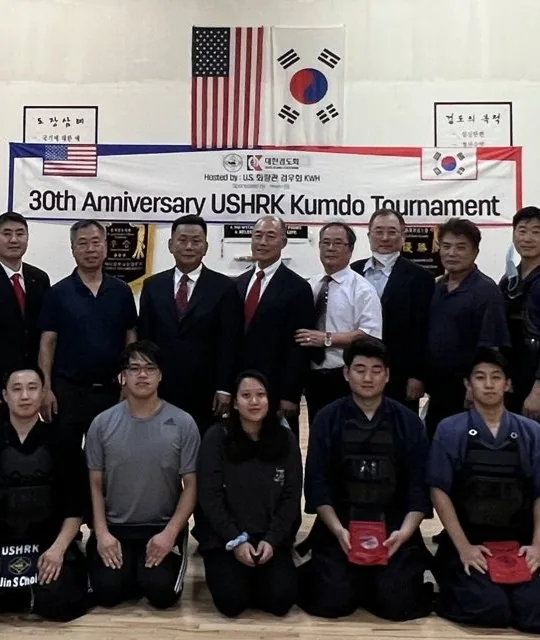
US Hwa Rang Kwan Kumdo is certified by the Korea Kumdo Association and teaches kids 7 years old and up, teens and adults in Chantilly, Virginia and Ellicott City, Maryland. New students at the Chantilly, VA dojang (training hall) can start with 3 semi-private lessons for $19.99. For the Ellicott City dojang, please contact us before you visit. Read more: Where can I learn sword fighting? · Kumdo sword, armor and uniform · What is Kumdo?
Sources
- Encyclopedia of Korean Culture: Hwando (in Korean)
- Encyclopedia of Korean Culture: Ring-pommel sword (in Korean)
- Encyclopedia of Korean Culture: Ungeom (in Korean)
- Encyclopedia of Korean Culture: Hyeopdogon (hyeopdo) (in Korean)
- Encyclopedia of Korean Culture: Muyedobotongji (in Korean)
- Encyclopedia of Korean Culture: Bongukgeom (in Korean)
- Encyclopedia of Korean Culture: Kumdo (in Korean)
- Joseon Dynasty Annals dictionary (Sillokwiki): Hwando (in Korean)
- Joseon Dynasty Annals dictionary (Sillokwiki): Mounted woldo (in Korean)
- Korea.kr policy briefing: The saingeom of the Joseon royal family (in Korean)
- Korea Kumdo Association: About Kumdo (in Korean)