 US Hwa Rang Kwan

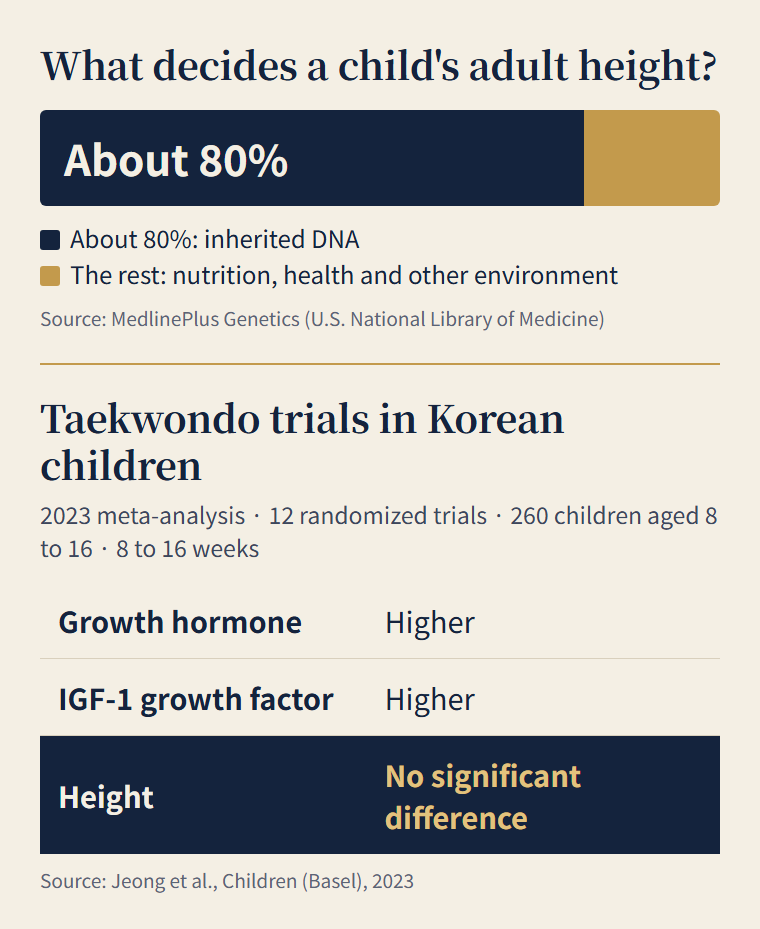
Research has not shown that it does. A 2023 meta-analysis of 12 randomized taekwondo trials in children aged 8 to 16 found higher growth hormone levels but no statistically significant difference in height. Scientists estimate that about 80 percent of a person's height is determined by inherited DNA. A 2019 review also found that physical exercise does not appear to impair a child's growth in height.
How much of a child's height is genetic?
MedlinePlus, from the U.S. National Library of Medicine, says scientists estimate that about 80 percent of an individual's height is determined by the DNA sequence variations they have inherited. More than 700 gene variants that affect height have been discovered. Environmental factors such as nutrition make a smaller contribution.
The American Academy of Pediatrics (AAP) says studies suggest that about 60% to 70% of differences in height are determined by the parents' height.
The AAP describes a rough way to estimate a child's adult height from the parents' heights:
- For a boy: add 5 inches to the mother's height, add the father's height, and divide by 2.
- For a girl: subtract 5 inches from the father's height, add the mother's height, and divide by 2.
The AAP calls this a very rough estimate, with a margin of error of about 4 inches up or down.
Does taekwondo or Kumdo increase height?
The closest research is on taekwondo. A 2023 systematic review and meta-analysis pooled 12 randomized controlled trials with a total of 260 children and adolescents aged 8 to 16. Most of the trials were done in Korea, and the training lasted 8, 12 or 16 weeks.
- Growth hormone: significantly higher in the taekwondo group than in the control group.
- Insulin-like growth factor (IGF-1): significantly higher in the taekwondo group.
- Height: a medium effect size, but the difference between groups was not statistically significant (p = 0.300).
The authors wrote that the short length of the trials is the likely reason, since children grow about 4 to 5 cm a year outside the peak growth spurt. They concluded that a longitudinal follow-up is necessary to determine the effect on height.
One small 2025 study points the other way. Fifteen children with short stature did jumping exercise for 24 weeks and gained more height than short children who were not given the exercise program. The study was not randomized.
These studies used taekwondo or jumping exercise, not Kumdo, so the results may not carry over to Kumdo.
Does martial arts stunt growth?
Research does not show that it does. A 2019 review in Jornal de Pediatria looked at studies published from 1990 to 2018. The studies did not demonstrate that practicing physical exercise or certain sports influenced the growth in height of children or adolescents. The authors concluded that physical exercise does not appear to impair a child's linear growth and that it contributes to the shaping of bone and muscle. They also noted that few of the studies had adequate methods.
Parents also ask about growth plates. A 2020 AAP clinical report says well-designed resistance training programs have not been shown to have a negative effect on growth plate health or linear growth in youth.
What helps a child grow well?
The AAP lists several things besides genes that affect how tall a child grows:
- Nutrition. The AAP says good nutrition is essential for healthy growth, and that too few calories, too little protein or missing key nutrients can slow growth.
- Hormones. Low thyroid or growth hormone levels lead to slower growth than expected.
- Medications and chronic conditions. Some medications and some chronic medical conditions can affect growth.
- Puberty timing. Children who enter puberty earlier often have a growth spurt sooner but may stop growing at a younger age.
- Daily habits. The AAP says sleep patterns, physical activity, diet and fitness can all impact growth.
Two guidelines give numbers for those daily habits:
- Sleep. The American Academy of Sleep Medicine recommends 9 to 12 hours of sleep per 24 hours for children aged 6 to 12, and 8 to 10 hours for teenagers aged 13 to 18.
- Activity. The CDC says children and adolescents aged 6 to 17 need at least 60 minutes of physical activity every day, including bone-strengthening activities such as jumping or running at least 3 days a week.
The National Institutes of Health explains that bones respond to exercise by making new bone tissue, which helps keep them strong.
What did a survey of Korean parents find?
The Korean Society of Pediatric Endocrinology surveyed 2,012 parents of children aged 5 to 18 in 2025, as reported by News1. Parents hoped their sons would grow to an average of 180.4 cm and their daughters to 166.7 cm. About 3 in 10 parents (28%) had given their child a height growth supplement, and 75.7% of respondents rated the effect of those supplements as "average" or "no effect."
The same survey looked at daily habits and found that more than half of the children exercised fewer than 3 times a week. The society's president, Hwang Il-tae, said growth is not a problem solved by short-term injections or supplements, and that enough sleep, balanced meals and regular exercise are the most important factors, as reported by Digital Times.
When should you ask a pediatrician about your child's height?
The AAP says to talk with your pediatrician if you are concerned about your child's height, or think your child may be growing too fast or too slowly. Growth problems are often easier to treat when they are identified early. Once a child finishes puberty and the growth plates close, the child can no longer grow taller. For Korean children, the 2017 Korean National Growth Charts use the 3rd percentile of height for age as the cutoff for short stature.
The AAP adds that what matters most is not whether a child is tall or short, but whether the child is growing consistently and as expected.
FAQ
Does taekwondo increase height?
A 2023 meta-analysis of randomized trials in children aged 8 to 16 found higher growth hormone and IGF-1 levels in the taekwondo groups, but no statistically significant difference in height. The trials lasted 8 to 16 weeks.
Does martial arts stunt growth?
A 2019 review concluded that physical exercise does not appear to impair a child's linear growth.
What sport makes you taller?
The 2019 review found that studies did not demonstrate that certain sports, including basketball, influenced the growth in height of children or adolescents.
Can a child grow taller after the growth plates close?
No. The AAP says that once a child finishes puberty and the growth plates close, they can no longer grow taller.
How much sleep does a growing child need?
The American Academy of Sleep Medicine recommends 9 to 12 hours for ages 6 to 12 and 8 to 10 hours for ages 13 to 18.
Kumdo for kids at US Hwa Rang Kwan
US Hwa Rang Kwan Kumdo teaches kids, teens and adults (ages 7 and up) in Chantilly, Virginia and Ellicott City, Maryland. New students at the Chantilly, VA dojang can start with 3 semi-private lessons for $19.99. For Ellicott City, please contact us before you visit. For more on children and martial arts, see Will Martial Arts Help My Child? and When Should a Child Start Martial Arts?
This article is general information and is not medical advice. Ask your pediatrician about your child's growth.
Sources
- MedlinePlus Genetics: Is height determined by genetics?
- American Academy of Pediatrics: How Tall Will My Child Be? (updated 2026)
- Effects of Taekwondo Training on Growth Factors in Normal Korean Children and Adolescents: meta-analysis (Children, 2023)
- 24-week jumping exercise in short-stature children (BMC Pediatrics, 2025)
- Effects of physical activity on children's growth: review (Jornal de Pediatria, 2019)
- American Academy of Pediatrics: Resistance Training for Children and Adolescents (Pediatrics, 2020)
- American Academy of Sleep Medicine: recommended amount of sleep for children (2016)
- News1: Korean Society of Pediatric Endocrinology survey of 2,012 parents (2025, in Korean)
- Digital Times: Korean Society of Pediatric Endocrinology press briefing (2025, in Korean)
- The 2017 Korean National Growth Charts for children and adolescents (Korean Journal of Pediatrics, 2018)
- CDC: Child Activity: An Overview (2025)
- National Institutes of Health (NIAMS): Healthy Bones