 US Hwa Rang Kwan

Martial arts may help focus and attention, but the evidence is limited. In a 2022 randomized trial of 240 children aged 7 to 11, an 11-week taekwondo course led to better teacher-rated attentional control and better attention on a flanker attention task, while several other measures showed no effect. These studies used taekwondo, not Kumdo, so treat the findings as a hint, not a promise.
What does the research say?
- 2022 trial, United Kingdom (taekwondo, 240 children aged 7 to 11, 11 weeks). Children in the taekwondo group were rated by teachers as having better attentional control and had better executive attention on a flanker task. No effect was found for teacher-rated inhibitory control, impulsivity or prosocial behavior, or for tests of response inhibition, working memory and switching. (Developmental Psychology, 2022)
- 2026 trial, China (taekwondo, 40 children aged 7 to 8, 8 weeks). Compared with regular physical education, the program improved attention stability and attention shifting. It had no significant effect on attentional breadth. (BMC Sports Science, Medicine and Rehabilitation, 2026)
- 2013 pilot study (taekwondo in middle-school PE, 60 students, 9 months). Parents rated taekwondo students as improving more in inhibitory control. This was a small pilot study. (Mental Health and Physical Activity, 2013)
- 2011 review in Science. The authors list martial arts among several activities, along with aerobics, yoga, mindfulness and others, that have been shown to improve children's executive functions.
- 2024 review of studies in adults (martial arts and combat sports). Most studies were cross-sectional. The link between martial arts or combat sports and abilities like inhibition and perception was consistent, but the evidence for attention and memory was limited.
The CDC also notes that a single session of moderate-to-vigorous physical activity brings an immediate benefit of improved thinking for children aged 6 to 13.
Why might Kumdo training ask for focus?
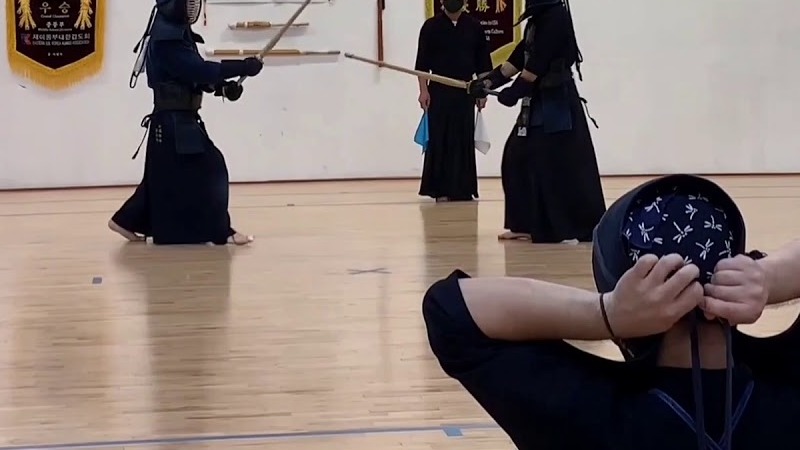
The Korea Kumdo Association says Kumdo training builds a high level of concentration and patience. In its rules, a strike only counts when it is made with full spirit and good posture, with the correct part of the sword and the edge facing the right way, and with alertness kept after the strike. Players also learn gi-geom-che il-chi: will, sword and body moving together with exact timing.
These are the association's descriptions of the training, not research results.
FAQ
Does martial arts help kids focus?
Some trials of taekwondo programs for children found better attention on certain measures, but not on every measure. Results from one martial art may not apply to another.
How long does it take to see a change?
The trials above ran for 8 weeks, 11 weeks and 9 months. Results varied by measure.
Train at US Hwa Rang Kwan
US Hwa Rang Kwan Kumdo teaches students 7 years and older, kids and adults, in Chantilly, Virginia and Ellicott City, Maryland. New students at the Chantilly, VA dojang can start with 3 semi-private lessons for $19.99. For Ellicott City, please contact us before you visit.
Sources
- Taekwondo trial in children aged 7 to 11 (Developmental Psychology, 2022)
- Taekwondo trial in children aged 7 to 8 (BMC Sports Sci Med Rehabil, 2026)
- Taekwondo pilot in middle-school PE (Mental Health and Physical Activity, 2013)
- Diamond and Lee, interventions for executive functions (Science, 2011)
- Review of martial arts, combat sports and mental health in adults (Psychology of Sport and Exercise, 2024)
- CDC: benefits of physical activity
- Korea Kumdo Association: about Kumdo
- Korea Kumdo Association: match and refereeing rules (PDF, 2023)